Taiwan's New Review Threshold for Data Centers Above 5 MW
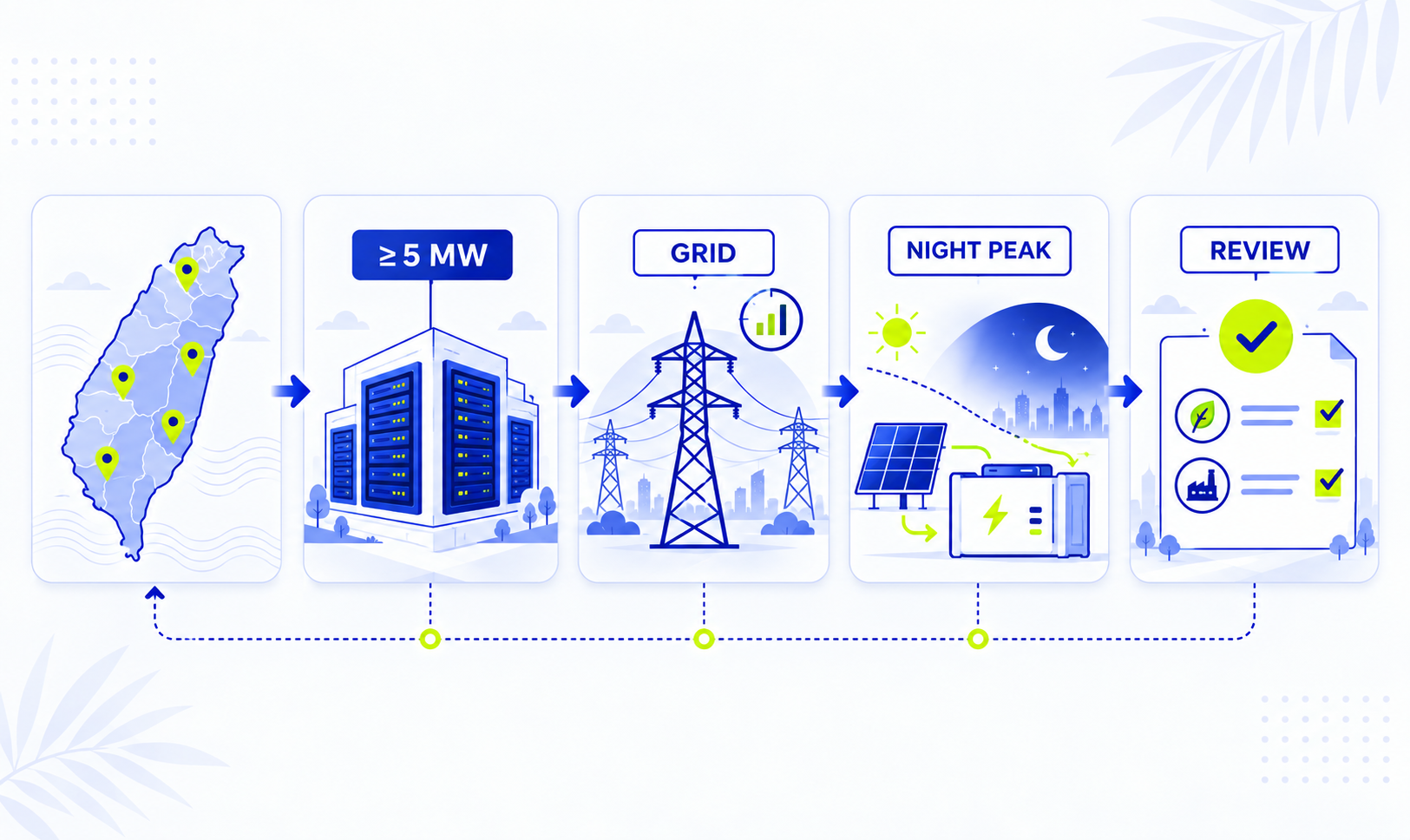
Five megawatts is more than an efficiency threshold. It changes the development sequence: large projects must demonstrate regional power feasibility, a credible night-peak plan, and local economic value before the site is fully committed.
Key terms
12 terms used in this guide, kept within a 20-term reading limit.
- 5 MW
- The electricity-use threshold relevant to the new data center review.
- Energy use statement
- A filing that explains large energy demand and efficiency design.
- Best available technology
- Advanced efficiency measures that are technically and commercially feasible.
- Supply capacity
- Power available from the regional grid or self-generation.
- Night peak
- The higher-stress system period after solar output declines.
- Demand management
- Measures that reduce maximum electricity demand in selected periods.
- Battery storage
- A system that stores and later releases electricity.
- PUE
- Total facility energy divided by IT equipment energy.
- Phased commissioning
- Bringing computing capacity online as confirmed power becomes available.
- Power co-location
- Locating large loads closer to available power resources.
- Industrial value
- Local investment, jobs, supply-chain, and technology benefits.
- Grid resilience
- The system's ability to withstand failures and rapid changes.
Start by separating current rules from the proposed amendment
Taiwan amended three regulations in November 2025 so that new or expanded hyperscale and colocation data centers using 5 MW or more must submit an energy use statement and apply best available technology during planning. A July 2026 proposal would add investment, employment, supply-chain, AI ecosystem, cybersecurity, and resilience benefits to the review.
- The 5 MW energy review is already in effect
- Industrial-benefit criteria were proposed in 2026
- Projects must follow the final rules and case-specific requirements
Research note: Investment models should track enacted obligations and proposed evidence separately so a draft is not presented as current law.
Insight 1: 5 MW changes the development sequence
The Ministry of Economic Affairs said projects should confirm a defined level of supply capacity with Taipower or a self-generation provider during site planning. Grid feasibility therefore moves from a late-stage connection task to an input for land and investment decisions. Cheap land can become the most expensive option when major network upgrades delay revenue.
- Obtain phased supply dates before purchasing or signing a long lease
- Separate initial, full, and expansion capacity
- Model network delays in revenue and financing cases
- Prepare a second-site or phased-load alternative
Research note: The central document is no longer only a land report. It is a load and supply plan that utility, engineering, and finance teams can verify.
Insight 2: northern constraints are regional, not a statement of nationwide shortage
Taipower has said northern grid load is rising quickly while electricity infrastructure can face delivery delays. It has directed high-demand AIDC projects toward central and southern regions with more available power and temporarily paused applications above 5 MW north of Taoyuan. The relevant question is not national generation alone, but whether a specific node can deliver capacity on a specific schedule.
- Compare connection schedules and upgrades across regions
- Value transmission, backup, and commissioning-delay costs
- Scale compute in phases that follow confirmed power
- Monitor regional network improvements and policy updates
Research note: A national supply balance cannot replace site review; the investment depends on power at the selected place, time, and load level.
Insight 3: solar improves daytime supply, but night peak needs a separate answer
The latest national supply outlook says strong solar output has shifted system pressure toward the night peak. Data centers operate continuously, so annual solar procurement alone does not demonstrate adequate nighttime supply. Developers still need a plan for storage, demand management, backup, and dispatchable resources.
- Plan with hourly load rather than annual energy alone
- Model the post-sunset load ramp and reserve requirement
- Separate peak reduction, shifting, and emergency battery duties
- Update forecasts with actual PUE and server utilization
Research note: Renewable targets and power reliability are connected but distinct. Both require time-based evidence.
The value created per megawatt is entering the review narrative
The proposed 2026 amendment adds five categories of industrial benefit. Large data centers may therefore need to demonstrate both efficient power use and local value. A project with high demand but limited employment, supply-chain participation, or AI spillovers may find that capital expenditure alone is not a complete public-interest case.
- Investment and economic output
- Direct and indirect employment
- Local equipment and service supply chains
- AI adoption and industry enablement
- Cybersecurity and operating resilience
Research note: A useful metric is the measurable industrial outcome per delivered MW, allowing energy use and local benefits to be compared on the same page.
A better development sequence
For data centers above 5 MW, energy planning should move to the front of the process. AI software can connect load forecasts, site-level grid evidence, storage simulations, and regulatory versions, but every result needs a source, assumption, and effective date.
- Build an hourly IT and cooling load profile
- Secure evidence for regional and phased supply
- Complete night-peak, storage, and backup scenarios
- Place PUE, cost, and industrial value in one decision model
- Only then commit land, equipment, and completion dates
Research note: The threshold does not stop data centers. It requires compute investment to answer earlier where power comes from, when it will be available, and what value it leaves in Taiwan.
Research sources
These sources support the market context and operating methods in this guide. Project decisions should use current local rules, contracts, and engineering evidence.